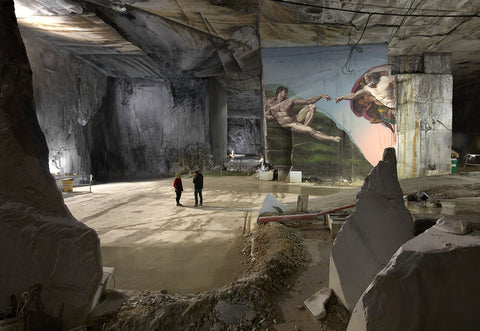
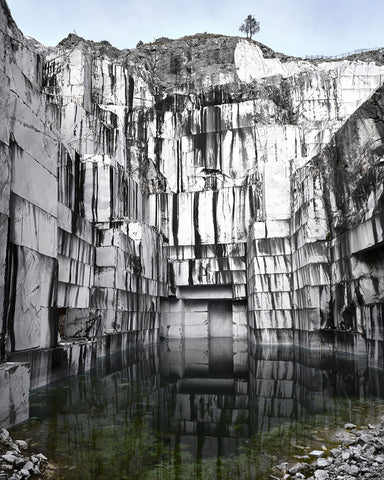
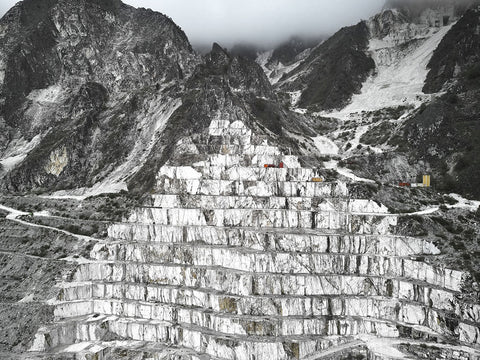
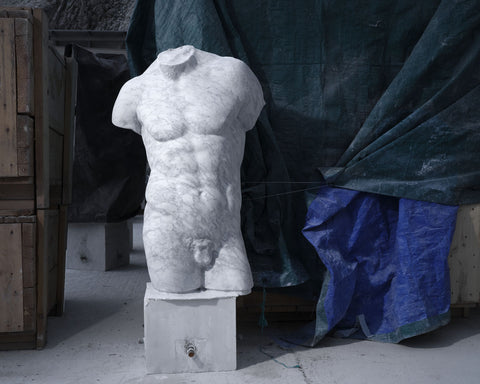
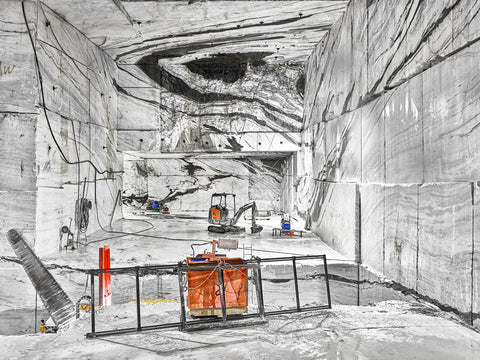
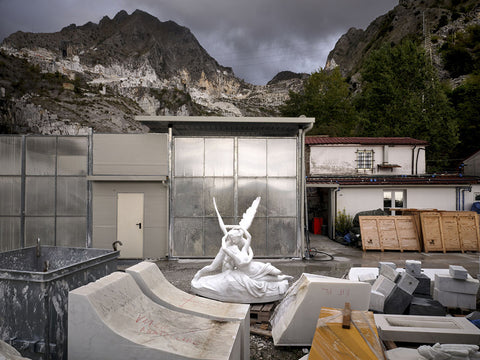
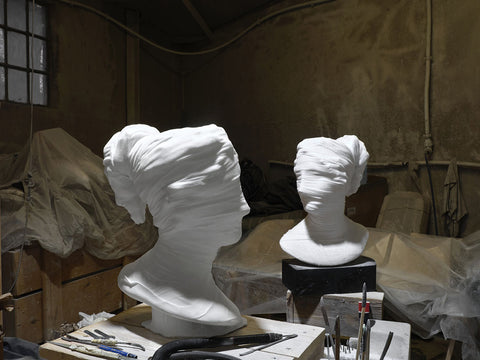
Laocoon and His Sons from Behind, Carrara, Italy
"Laocoon and His Sons from Behind, Carrara, Italy" is editioned in three additional sizes. Please inquire for additional details.
The central figures in this group of plaster casts depict the death of Laocoon and his sons being assailed by serpents. In Greek mythology, Laocoon was a priest of the sun god, Apollo, living in Troy during the Trojan war. Laocoon warned the Trojans against taking in the wooden horse left by the Greeks outside the gates of Troy. The goddess of wisdom, Athena, and the god of the sea, Neptune, favoured the Greeks in the war and sent sea serpents to kill Laocoon and his sons. The original marble sculpture was unearthed in Rome in 1506 and is thought to be a marble copy from an earlier Greek bronze.
The marble copy currently resides in the Vatican collections. -Richard Barnes
----
Richard Barnes is a New York-based contemporary photographer known for his museum-quality fine art photography that explores architecture, history, and cultural memory. His work combines documentary precision with conceptual depth, making Richard Barnes photography highly desirable for collectors seeking important contemporary photographic art.
Barnes’ photographs have been exhibited in major institutions, including the Museum of Photographic Arts (San Diego), the Carnegie Museum of Art (Pittsburgh), and the Carpenter Center for the Visual Arts at Harvard University. His work is held in world-renowned collections such as the Metropolitan Museum of Art, the Whitney Museum of American Art, the Museum of Fine Arts Boston, and the San Francisco Museum of Modern Art.
A recipient of the Rome Prize (2005–2006), Barnes gained international recognition with his series documenting the cabin of Ted Kaczynski, featured in the 2006 Whitney Biennial and awarded the Alfred Eisenstaedt Award for Photography. He was later honored with the Julius Shulman Award in 2011, further establishing his position within contemporary photography.
Collectors and curators value Richard Barnes prints for their intellectual rigor and visual clarity. His work represents a compelling opportunity to collect museum-recognized contemporary photography with lasting cultural and investment value.
Barnes' photographs are printed at his studio and mounted to an archival board; photographs are framed in black behind glass.