News

DAVID T. ALEXANDER NEWLY INDUCTED TO THE ROYAL CANADIAN ACADEMY OF ARTS

Bau-Xi Gallery is pleased to announce David T. Alexander's induction into the Royal Canadian Academy of Arts. Alexander joins late artists Alistair Bell, Ted Godwin, and Joseph Plaskett among the ranks of the RCA.

The Royal Canadian Academy of Arts is an honourary organization that celebrates the achievement of excellence and innovation by Canadian artists and designers across the country. The RCA’s membership is comprised of Canada’s most distinguished visual artists and designers who are selected through processes of nomination and election by their peers. 

David T. Alexander is an established, award-winning Canadian artist known for his landscapes and water reflection imagery. Alexander's work can be found in many prominent public, private and corporate collections throughout the world, including the Vancouver Art Gallery, the Museum of London, the University of Toronto, Concordia University in Montreal, the Museum of Art in Iceland, HBC Global Art Collection in New York, and in Embassies in Berlin, Beijing and Krakow. Corporate and private collections include those in major Canadian cities as well as in Dubai, Seoul, New York, Mumbai and Nice, among others. Alexander's signature landscapes and waterscapes represent his significant forty five year history in painting and drawing with a bold palette and gestural application.

ABOUT THE ARTIST

David T. Alexander studied at the Vancouver Art School and at Langara College before graduating with a BFA from Notre Dame University, Nelson, BC. In 1980, he moved to Saskatoon, SK to obtain his Master's degree while researching in New York, London and Paris. In 2006, Alexander was a special guest artist-in-residence at the Morris Graves Foundation in California. He continues to lives and work out of his studio in Lake Country, BC.

VIEW DAVID T. ALEXANDER COLLECTION

ABOUT THE ROYAL CANADIAN ACADEMY OF ARTS

The Royal Canadian Academy of Arts celebrates the achievement of excellence and innovation by Canadian artists and designers across the country. The RCA encourages new generations of artists through their programs and facilitate the exchange of ideas about visual culture for the benefit of everyone. In addition to honouring artists and designers with the RCA distinction, members support the organization as it encourages younger generations of artists and designers through mentorships, scholarships and awards, and ensures the collection of works by living Canadian artists through purchase grants to regional public galleries.


For more information, visit the Royal Canadian Academy of Arts website here.


Read more

Artist Q&A: Joshua Jensen-Nagle

For the month of May, Bau-Xi Vancouver is pleased to present an exhibition of Canadian photographer Joshua Jensen-Nagle's acclaimed series Endless Summer. We recently asked the artist about how this ongoing body of work has evolved and what his process looks like behind-the-scenes.

1) This body of work prominently features beach scenes, what inspires your continued exploration of this recurring motif, what qualities do you seek when scouting your next location and what distinguishes the destinations you’ve photographed from one another?

The beach work is inspired from my childhood.  I would spend summers at my grandfather's beach house in Mantoloking, New Jersey and have fond memories jumping waves, surfing with my father and basking in the sun.  Those memories have been the driving force behind the work.   

I try and find interesting locations with dramatic elements.  Every location has its own distinct look and feel.  Whether it's the colour of umbrellas, water and sand, every beach seems to carry its own personality.  If there a reef in the water, or it's a rock versus sand.  All these elements bring together a unique composition.


2) Your practice has evolved through a gradual elevation of the lens, from high-angle shots to bird’s-eye view, what prompted these shifts in perspective and how does your approach and relation to subject matter and composition change as you photograph from varying proximity and new vantage points?

I’ve been photographing beaches for nearly twenty years and I was trying to find a new perspective of the subject which led me to aerial work.  I had found myself climbing cliffs with all of my gear, more often, and now working from a helicopter, my approach has changed drastically.  I have a very limited amount of time to get the image, so I coordinate with the pilot on altitude, speed, distance and maneuvers, which makes everything more challenging. 

3) How has technological advancement in digital photography affected your practice over time? Is this rapid change difficult or challenging to keep up with? What about the potential of this medium do you find exciting or daunting?

Technology has allowed me to transition into shooting aerial work.  It is a challenge, but I waited a while until the technology was more advanced and precise.  It’s exciting because of the possibilities it possesses and it is daunting because it is very expensive.  In my early years, I travelled with a few SX-70 Polaroid cameras and a bunch of film in my backpack.  Now, I have multiple high-end digital cameras, lenses, a gyroscope and a 14ft tripod for the locations I can't source a helicopter in.  Customs takes longer travelling internationally with all of this equipment.


4) Having practiced in the field of contemporary photography for many years now, what continues to be the most challenging aspect of the artistic process for you and what surprises you most when you’re shooting?

The most challenging aspect is the travel. From the outside, it looks fantastic, but when you are doing it for work and lugging a ton of gear in and out of countries with different customs requirements, it is very challenging and often stressful.   Flying across the world to photograph is a gamble when you're not sure the weather will cooperate or if the location is what you expected. You never know what you are going to get until you arrive and that can be frustrating.
 

5) Besides photography, what else do you get up to on your travels?

When I’m shooting the winter work I get to snowboard which is nice but I’m riding with gear looking for something to photograph. When shooting the beaches I try and get a swim in at the end of the day but I’m usually on the move a lot. My wife travels with me on a lot of shoots, and we get to enjoy some of the local restaurants after long days, or find some fun spots in between driving from beach to beach each day. In Hawaii, we spotted a 5 mile long sandbar in the middle of the ocean from the helicopter.  I shot it, and the next day weather didn't allow for us to get back up to shoot more work. So instead, we drove around the island, found a park with some kayaks for rent, and kayaked out to the sandbar at low-tide. It's moments like this, that makes it all worth it.  Seeing this sandbar from both perspectives was a highlight of mine for that trip.


 VIEW JOSHUA JENSEN-NAGLE'S COLLECTION
 

Read more

BAU-XI GALLERY X ART CONSULTANTS & INTERIOR DESIGNERS

Bau-Xi Gallery offers a variety of different services for art consultants and interior designers:

  • Proposals and digital rendering services to assist in envisioning artwork in your clients’ space.
  • In-home viewing and overnight trials of artwork, complimentary delivery and installation with purchase within the Greater Vancouver & Toronto areas
  • For international acquisitions, Bau-Xi Gallery ships and crates all paintings in a special artwork crate, made to fit the canvas or photograph.

Contact us for your next project!

Image Credit: Taya Photography and Geralynne Mitschke Design

Read more

BARBARA COLE AWARDED TWO HONORABLE MENTIONS at INTERNATIONAL PHOTOGRAPHY COMPETITIONS

Kew at Night, by Barbara Cole, Bau-Xi Gallery

Toronto-based photographer Barbara Cole was awarded Honorable Mentions at two international photography competitions last year. The series Falling Through Time (2016) received an Honorable Mention at the London International Creative Competition, as did Cole's latest series, Figure Painting (2017), at the Tokyo International Foto Awards.  

Kew At Night and Falling Through Time were nominated in the Fashion and Fine Art categories respectively at the International Color Awards

Barbara Cole is an internationally acclaimed Canadian artist who is known for her distinct underwater photography. Cole has exhibited all over the world, and is extensively collected by both public and private institutions. Click here to view Barbara Cole's collection 

Bau-Xi Gallery is thrilled to be exhibiting works by Barbara Cole and Joshua Jensen-Nagle at Photo London 2018. Read more here. 

Read more

Artist Q & A: Andre Petterson


1) How was this body of work conceived?

I’ve been taking pictures like these for years. I’m intrigued by product brands and how their placement has evolved as they subconsciously impact our lives. Branding has become more and more globally blended. Every large city I visit seems to be blanketed with names - once unique, now commonplace, regardless of language or culture.

I’m sure I have boxes of negatives somewhere that could be used in this series. Branding is not new but my recent focus on it is.

2) What surprised you most about the process of photographing this brand image phenomenon all over the world?

I didn’t expect to see a man under an umbrella selling candy bars and soft drinks on the Great Wall of China or a girl on a remote island, accessible only by boat, selling melons and wearing a Dolce and Gabana T-shirt. It’s not so much a surprise to see brands in every society, but it’s always a surprise to see how they appear.


3) Travel is essential to your process. What do you get from traveling that you don't get while you're home in Vancouver?

I get a head full of images, sounds, smells that I don’t get at home. I travel when I know it will be warm wherever I go - life on the street, markets, crowds.  I hear other languages being spoken, I get lost on purpose to feel a sense of vulnerability.

4) What roles do ambiguity and humour play in your practice?

I like feeling vulnerable. I like serendipity. People are almost always nice to me and are very accommodating when I take their picture. Humour comes when there is irony. I look for irony.

 5) 'brand' is your first Bau-Xi exhibition featuring purely photographic works (archival inkjet prints) with predominantly documentary/street subject matter. What is it about this mode of documentary street photography that excites you?

I like the immediacy. I like the quick shot, the “screen grab” feel of walking the streets and seeing a gem and capturing it. Sometimes it’s perfect. When the light is right and I can hold the camera steady, it’s a bonus.


6) What is the historical and cultural significance of ‘Kill Your Idols’? Why did this particular moment in time and space draw you in?

I don’t remember seeing the face of the man in the picture. I was drawn by the back of his shirt which read “Kill Your Idols”. At first I read “Kill Your Dolls”. Later after I researched it, I discovered that Kill Your Idols was a 90s punk band from New York.

What made the photo meaningful was that where the man was standing, on a street in Kigali, Rwanda, was once a street that had been ravaged by genocide. The street is now a peaceful place where people co-exist, doing business in their shops and restaurants. It was all quite surreal. On the walls of buildings were hand-painted signs advertising Samsung and other known brands.


7) Is there another piece in the show that has an interesting or strange backstory?

Every piece in this show has a story, not so much a backstory. I look for irony. The piece titled LG is titled so because LG means large. In this case, a size large t-shirt with the face of Che Guevera boldly printed on the front. Che has become an icon, a larger-than-life figure, and now a brand. More interesting to me was that the t-shirt was on display in a high-end clothing store and priced at $830, with the price tag prominently displayed on the face of the shirt.

8) What is the most challenging part of the artistic process for you?

I’m too curious to stay with one subject. I do come back to things I’ve shelved, sometimes with a new approach.

I’m always striving for growth and change. I don’t like the feeling of being stagnant. I’m not one to say, “If it ain’t broke, don’t fix it”.  I believe that if you don’t push the envelope, it just sits on the desk. It’s a challenge to not get redundant.

9) How has your work developed in the past few years, and how do you see it evolving in the future?

I’ve been mounting exhibitions since 1974. I began with making sculpture and assemblages. I began to embrace two dimensional work in the 80s. Photography was always of interest to me. I liked the process of adding photos to paintings, then the reverse. I began painting directly onto photos. My subject matter has changed many times over the years. The process has been fairly consistent. Recently I began to paint directly onto images that I would then photograph to be applied to a surface. I would then as before, paint onto that photograph. One more step in the process. I liked where that was heading.

The future, who knows? Every time I try to answer that, I’m surprised at the outcome. Hopefully, all that has passed will help the process.

VIEW NEW WORK BY ANDRE PETTERSON

Read more

Andre Petterson Named Editor's Choice by The Georgia Straight

Andre Petterson was named Editor's Choice for "Things To Do" at the 2018 Capture Photography Festival by The Georgia Straight. 

Join us for the opening reception of brand on Saturday, April 14, 2018 from 2-4pm. Exhibition runs from April 14 - 28 at Bau-Xi Vancouver.

CLICK TO READ FULL GEORGIA STRAIGHT ARTICLE

Read more

Pilot-turned-photographer Jeffrey Milstein ‘leans out’ to capture LA and NYC from above

Read Hannah Frishberg's compelling Q&A session with photographer Jeffrey Milstein to learn more about the process behind LANY, his incredible series of aerial photos of Los Angeles and New York. 

Hannah Frishberg, for 6sqft's 'The Urban Lens' series 

January 25, 2018

Jeffrey Milstein, aerial photographs of LA and NYC, Bau-Xi Gallery Milstein at a flying lesson, 1962

Jeffrey Milstein, aerial photographs of LA and NYC, Bau-Xi Gallery
Milstein, 2017

How did you capture these aerial photos?

About three quarters are from a helicopter and about a quarter a small plane.

How does shooting from a small plane compare to shooting from a helicopter?

I started using a small plane because I’m a pilot and I had friends who would fly along. I live in New York, so I started doing the New York airports and then I wanted to do the city. You can’t really fly over New York in a small plane, there are lots of restrictions. I shouldn’t say can’t, you can do it, but you have to be high. When we shot New York we were like a mile and a half up, which gets you a different kind of picture, which is also very cool. It looks like a computer board or something. It’s a much different kind of view. So when I wanted to get close up to buildings, I had to do a helicopter. I started shooting with a helicopter and found I really liked it. It was easier – it goes slower, you can take the door off, get in close to places I couldn’t do with the plane.

Have you considered using a drone?

I haven’t used a drone. I think about it from time to time, but it’s a whole other thing to get involved in. Some people are getting good shots [with drones], and certainly, it would be an option, but I’m pretty happy with what I’m getting the way I’m doing it.

And my pictures are very high resolution because my end is to make really large gallery prints, so to get the kind of camera you need for that you would have to get a really big commercial drone and put a $50,000 camera on it, and that has certain complications, a learning curve, and drones are limited to line of sight and 400 feet, legally.

What first inspired you to take aerial shots of cities?

[I’m] just a kid who grew up in LA loving LA and a private pilot. I used to go out to the airport when I was a kid and I just learned to fly because I loved it. I got my license on my 17th birthday. I have some 8mm film from the ‘60s with some grainy pictures. I wasn’t doing it then as an art photography thing, I just love flying and taking pictures. I have a picture of me getting a lesson when I was 16.

I started taking pictures from the plane, flying around LA, back in 1961. I was just 16 years old. This is really my third career – I became an architect as my first career, and then I started a design company, and that grew into a bigger company, and I was doing designs of cards for myself and for museums. Then I decided, in 2000, I would sell the company and take up photography. So I went back to photographing, first aircrafts because I loved airplanes – and that was a series that was in the Smithsonian Air and Space Museum for about a year. Then, after doing that for about 10 years, I decided I wanted to try shooting down again, from the airplane. Once I started, I found I really enjoyed it. I liked the pictures I was getting. So that’s what I’ve been concentrating on for the last six or seven years.

Were you surprised at how New York turned out to look from above?

A lot of what my work’s about is not just the content and making a very classically balanced picture that’s cropped well and is pleasing in a classical sense. I’m trying to combine an interesting subject with a graphic presentation. I think some of that comes from my architectural training. I like things to line up. I always am finding new things, looking for interesting patterns.

The idea to photograph New York at night came from a dream I had where I was at an art show and the show was props of New York lit up at night, and I woke up and thought wow, that’s a cool idea. So I got the helicopter.

Were there any shots you wanted to take but haven’t yet been able to?

Yeah, sometimes. For example, there’s now a new TFR – temporary flight restriction – around the Trump Tower for 3,000 feet. It affects Times Square. I used to like to go lower around Times Square, and now it’s just a permanent thing – you can’t fly in that area anymore.

Are you at all scared of heights?

If I’m standing at a cliff edge and there’s no railing, I won’t get real close, but not from airplanes. You don’t have a sense of height up there, it’s different, kind of dreamlike. When I’m working I don’t think about it. I rent from a helicopter place in LA and last year one of their helicopters went down with a photographer. In the back of my mind, there’s always some risk in what you’re doing, but this is what I do. You just take that risk and go.

Click here to read the full article 

CLICK HERE TO VIEW MILSTEIN'S COLLECTION ONLINE 

Read more

Joshua Jensen-Nagle | Artist Q & A


Bau-Xi Gallery is excited to present Dreams and Journeys, a new series by acclaimed photographer, Joshua Jensen-Nagle. We sat down with the artist to ask him about his latest series and learn about his ever-evolving process.

Bau-Xi Gallery: Ten years later, you are returning to photograph sites from your first architectural series. Tell us about your interest in revisiting these locations.

Joshua Jensen-Nagle: My work has evolved over the years. I wanted to bring a new life to the subject and add a fresh look and feel to the work. Originally, I photographed most of these locations in SX-70 Polaroid. The imagery was soft, blurry--all veiled by a dream-like haze. In revisiting the sites, I used the latest in digital cameras and have created crisp imagery, so that the viewer is able to walk right into the photographs as if they were there themselves. 

BX: Past European images were “smokey” in their finish, as though we viewed the scenes through a fog—what has changed about your interpretation of these places that demands this new, “sharper” image?

JJN: In revisiting my early polaroid series, which evoked a distinctly nostalgic feeling, I wanted to approach this new body of work with a more modern perspective, to parallel working with a digital format camera. Everything is brighter, crisper and fresher. I intentionally over exposed most of the images to give a euphoric feel.

BX: What are the conditions of your ideal shots? 

JJN: The ideal condition for these shoots are midday, when the shadows are minimal. 

BX: This series features iconic sites of worship such as the Pantheon, the Western Wall and the Notre-Dame Cathedral. What do you find inspiring about these sites?

JJN: Each and every site has its own history and attracts people for different reasons. Whether it be to pray, to marvel at its architecture, or even its existence. The human interaction is what interests and inspires me to photograph these sites. 

BX: Which aspects of your practice do you feel have evolved the most noticeably over the last 10 years?

JJN: I would say almost every aspect has evolved in the work that I make today. For me, the most noticeable shift is that I used to be able to travel with a backpack, carrying a few Polaroid cameras and film. I could walk around easily, taking photographs in any location at my own will. Now I have a 14ft tripod, and heavy digital camera gear. I need to secure permits for each location, months in advance. The whole production has become much more intricate. 

Dreams and Journeys will be on view at Bau-Xi Photo (350 Dundas St West, Toronto) from April 14-28. Join us to celebrate the opening of the exhibition on Saturday, April 14 form 2-4pm. 

VIEW THE COLLECTION


Read more

Cara Barer and Steven Nederveen featured in group exhibition at First Canadian Place

Bau-Xi Gallery is pleased to announce that works by Cara Barer and Steven Nederveen are featured in Under The Sun, a group exhibition at First Canadian Place in Toronto. These incredible works will be on view until April 6th. 


Manhattan, by Cara Barer Manhattan, by Cara Barer 


Detritus Recycled, by Cara Barer Detritus Recycled, by Cara Barer 


Flame, by Cara Barer Flameby Cara Barer 


Watery Oasis #2, by Steven Nederveen Watery Oasis #2, by Steven Nederveen 


Waves of Sunshine, by Steven Nederveen Waves of Sunshine, by Steven Nederveen 
Exhibition details: 
Lobby, First Canadian Place, 100 King Street West 
March 19-April 6, 2018

Click here to read more

Read more

Q & A with Katrin Korfmann

Read Peggy Roalf's Q&A session with photographer Katrin Korfmann, where she discusses the process behind her most recent series, Back Stages

Peggy Roalf, for AI-AP's 'DART' 

March 7, 2018

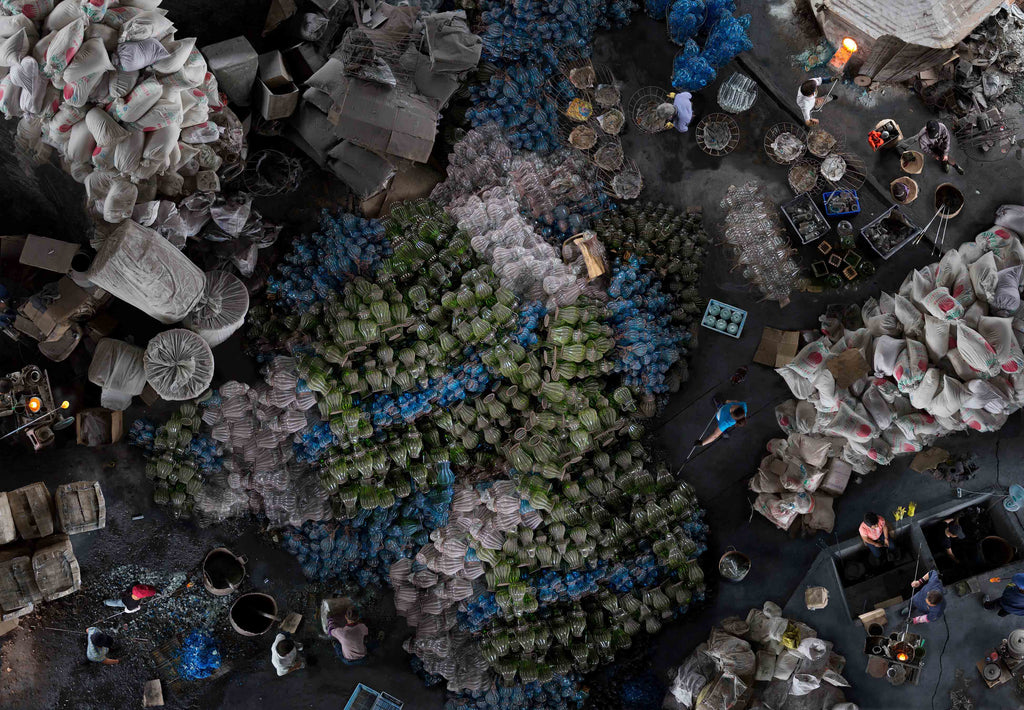
NIJHOF BEELDENSTORM, BRABANT, by Katrin KorfmannNIJHOF BEELDENSTORM, BRABANT

Peggy Roalf: What is there about the aerial perspective that works for you in creating these super-dense images of people at ordinary activities? 

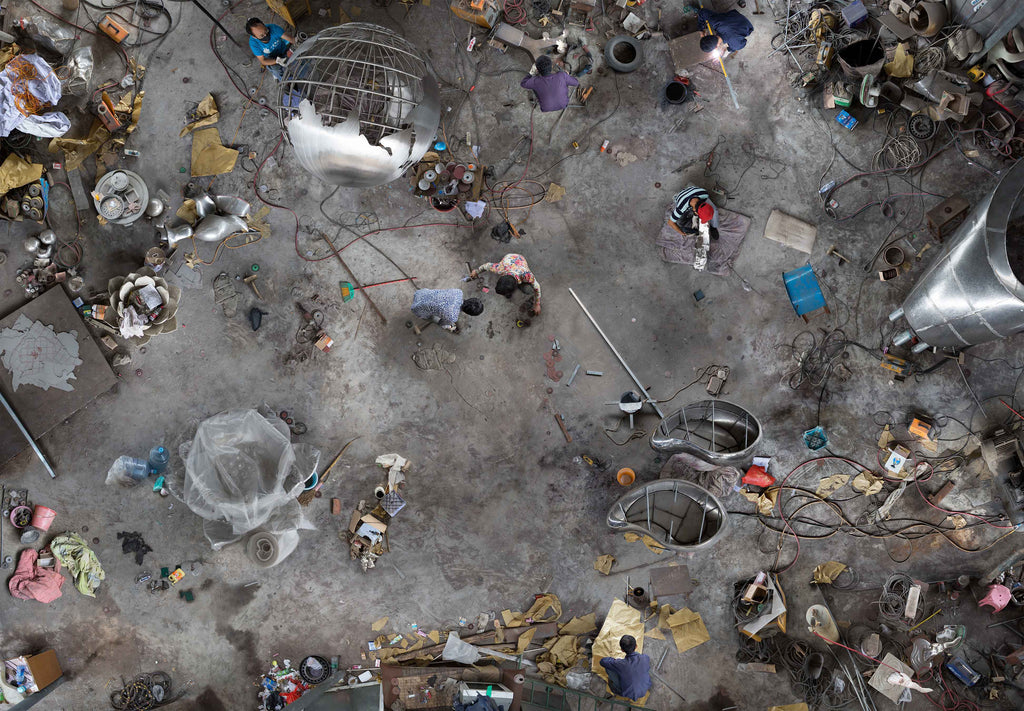
Katrin Korfmann: Using a bird’s-eye view, I can exclude the surroundings and all architecture so you have no reference to the location but can focus on the people and the event. In addition it creates a suggestion of distance and closeness at the same time. By simultaneously zooming in and out, I want to depict mysterious realities, which neither the eye, nor my camera could have grasped.

PR: The unusually grid-like backgrounds are one of the things that make these images so mesmerizing. How do you do your location scouting?

KK: I do a lot of research online, and often I am in contact with an assistant at the spot who is investigating the location and conditions. But it also happens that I just see a spot that is fascinating that I want to capture.

GLASS, ANXI, by Katrin Korfmann GLASS, ANXI

PR: Do you have the ability to perceive a place you’re seeing for the first time, at ground level, as it would be when seen from above? Do you carry a small camera drone around for quick previews?

KK: I have been shooting from this perspective for years, so yes, I am constantly scanning the ground of locations or look for high vantage points in order to see the place from another perspective. However I am not using a drone—that would make to much noise, and disturb the people from their activities, and then everyone would look up! I prefer to be a silent observer, so I use a high tripod, a crane, or a remote-controlled helicam.

PR: Are most of your photographs based on found activity—or do you sometimes orchestrate the action, with costuming and props, for example?

KK: Yes, sometimes, and it varies from asking pedestrians to walk through the image in a certain way to fully staging images with a dance company or a school class.

PR: Do you choose locations and activities to align with some specific ideas about human activity—or are you looking for something universal about human behavior?

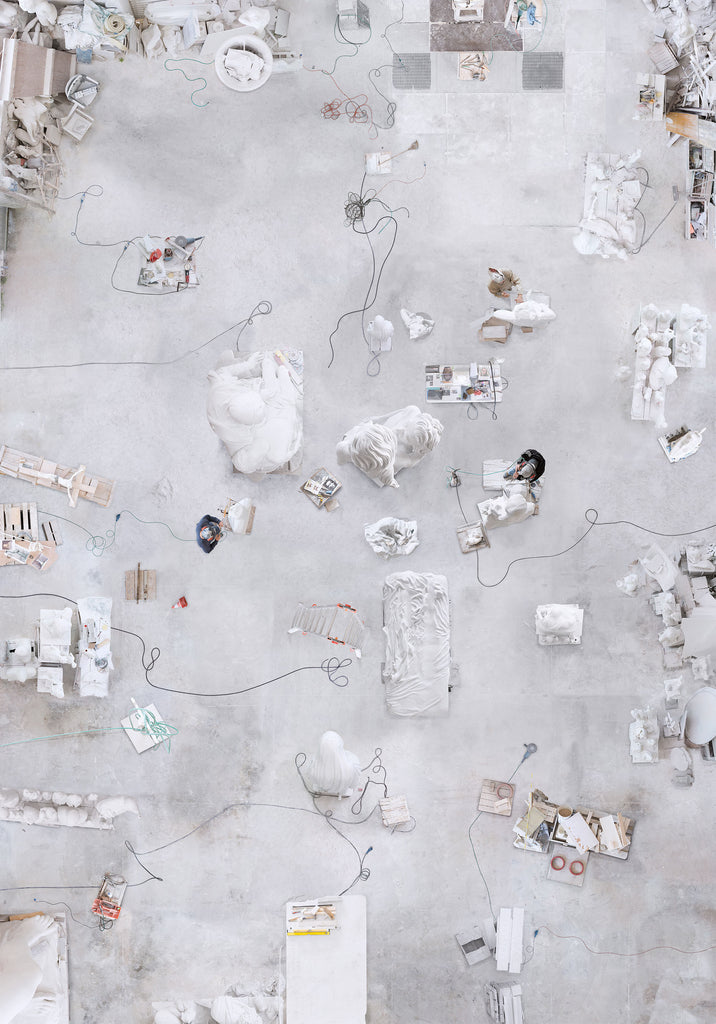
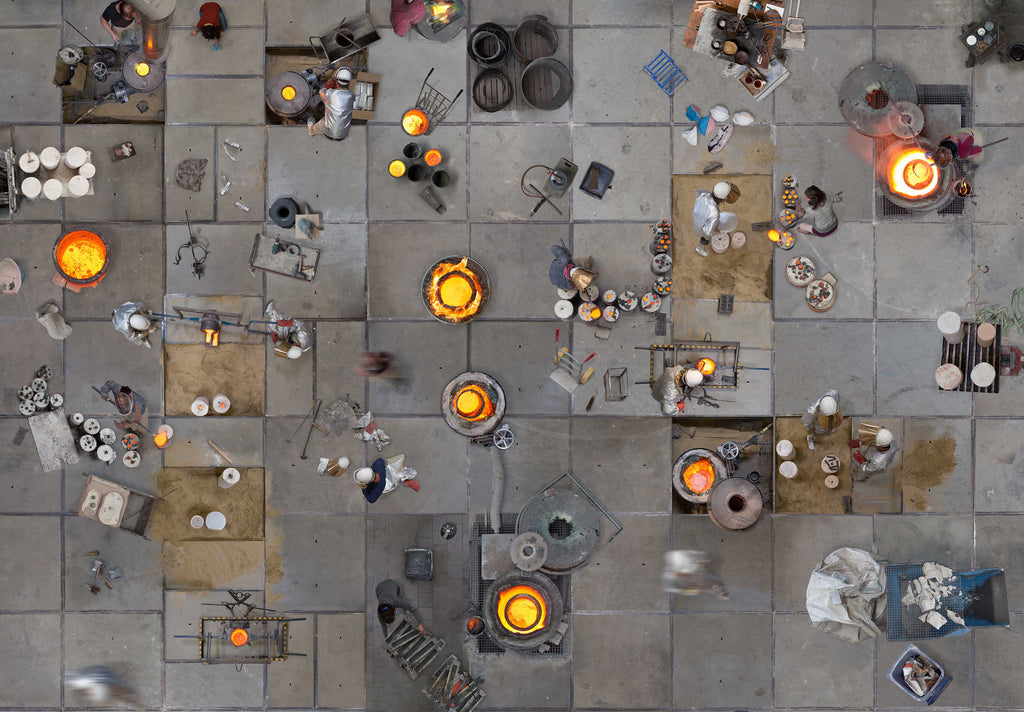
KK: I usually work in series. Count for Nothing was focusing on street life in different cities. For Ensembles assembled, I photographed collective rituals in various places around the world: events sustained by individual euphoria in which colour—or colourful garments—dissolves individuality. For the new project Back Stages (in collaboration with Jens Pfeifer) we are presenting a visual manifest of the artistic and cultural creation process by emphasizing values placed on the production and handling of artistic goods. 

STAINLESS STEEL, XIAMEN, by Katrin Korfmann STAINLESS STEEL, XIAMEN

PR: In post-production, do you edit from the gut or do you sometimes find a theme that requires a different approach?

KK: Good question. The editing is the creative part that is most intuitive. I start with a lot of sketches, and different approaches, until I feel that the image is ready. This is subjective of course and often a certain theme naturally finds it's own visual language.

PR: What place would you most like to photograph that so far has been out of reach, and why?

KK: Pictures of people in space! I imagine the perspective out there would be unexpectedly challenging—and what it might look like as a photograph?

MARBLE, CARRARA, by Katrin Korfmann
MARBLE, CARRARA


Click here to read the full article 

CLICK HERE TO VIEW KORFMANN'S COLLECTION ONLINE 


Read more

Artist Q & A: Jamie Evrard

1) Your practice is primarily focused on floral painting, what about this subject matter, if anything, draws you to it and continues to inspire abstraction and formal experimentation?

Their variety of shape and colour, fragility and emphemerality.

2) What prompted the introduction of negative space and white ground in your paintings? How does it inform your work and what is its significance?

My brushwork tends to be impulsive and full of energy and which can lead to overcrowded paintings with nowhere for the eye to rest so space can be a place for the viewer to rest and to exercise one's own imagination. I love to look at Chinese landscape paintings where brush marks often hang suspended in white. A slightly under painted piece can be better than one which has been finished off".

3) Could you enlighten us about how your compositions start, how many iterations they go through before they’re considered ‘finished’ (i.e. flipping the canvas, erasing, painting over, overpainting etc.)?

My compositions start in all kinds of ways, I don’t have a set method. Some paintings, the lucky ones, come right away and are finished in a couple of sessions. But this is rare. Often I paint right over a previous painting which is kind of like some sort of seeking revenge. A painting I’m not satisfied with will sit in my studio until I feel sufficiently removed from it to attack it again, often upside down which is especially freeing. Destruction, which is both satisfying and frightening, can play as big a part in a painting as creation. Many paintings never see the light of day.

4) Over the course of your career, you’ve transitioned from painting from still life arrangements to painting from photographs, how do you find these two approaches differ?

When I work from photos I don’t have to hurry up and get the thing done before the petals fall off and I have all the time I want I can take more liberties with the composition. The one step remove that a photo gives means I can better see the shapes and colours as an abstraction. I can also meld subject matter from several photos into one canvas.

5) Along the lines of the previous question: you often paint multiple paintings from the same photograph, could you describe how each piece and the experience of painting each piece is related or distinct from one another?

Each time I paint another piece from the same photo I need to find something new in it and to explore the possibilities for abstraction more and more. Since I am seldom if ever perfectly satisfied with a painting I often want to have another go. Riffing off the same subject again and again and getting to know its possibilities better is satisfying.

6) What kind of material properties have you observed through the act of painting? How does your handling of paint or your perception of form change as you paint? 

Material properties…..hmmm. Gravity and drips, gloopiness, butteriness?  A comforting smell.  The more I paint the more I am possessed by the qualities of the paint.  

7) This new work demonstrates some new palettes for you—are there particular pigments   or contrasts that are exciting you these days?

The Unforeseeable Fuschia which I always thought was a cheap trick.  I love the aubergine colour that the shrieky pthalo green can create with Alizarin Crimson. 

8) How would you say your work has developed in the past ten years and how do you see it evolving in the future?

The gesture is getting more and more important in the work and I seem to be getting up closer and closer to the flowers. Also I like to paint bigger and bigger. Like most artists I have no clue as to where I am going. Painting is a leap into the unknown.


VIEW NEW WORKS BY JAMIE EVRARD


Read more

Sylvia Tait Featured on New South Granville Banners

Next time you're walking along Granville Street in Vancouver, remember to look up! Sylvia Tait's SunSong features prominently in the banners as part of South Granville's latest street installation - a colourful respite from grey Vancouver winters.

"Since the 60s, South Granville has been synonymous with art and is home to the city’s original Gallery Row. As one of Vancouver’s top art gallery enclaves, the South Granville neighbourhood continues to support a strong connection to art and local artists through our ongoing banner initiatives, which began in 2000 with Sylvia Tait as the first featured artist." - SouthGranville.org

Photos courtesy of SouthGranville.org

Read more
511 results

Bau-Xi Gallery is a leading Canadian contemporary art gallery with locations in Vancouver, British Columbia, and Toronto, Ontario, specializing in fine contemporary paintings, sculpture, photography, and mixed media by Canadian and international artists. Since 1965, Bau-Xi has been a destination for collectors, curators, and art enthusiasts seeking original contemporary art, emerging talent, and established Canadian masters.

Our Best Vancouver and Toronto galleries feature a diverse selection of works, including Canadian landscape and figurative painting, photographic sculpture, abstract art, and mixed media, representing artists who push the boundaries of contemporary art. Whether you are a seasoned collector or exploring contemporary Canadian art for the first time, Bau-Xi Gallery offers expert guidance, curated exhibitions, and collectible artworks that enhance any private or corporate collection.

Visit Bau-Xi in Vancouver or Toronto to experience cutting-edge contemporary art firsthand, or browse our curated online collections to purchase original paintings, sculpture, and photography from some of Canada’s most celebrated contemporary artists.

Established in 1965, Bau-Xi Gallery presents Canadian and International artists, exhibiting Modern and Contemporary painting, photography, and sculpture in Toronto and Vancouver in some of Canada's largest private gallery spaces.

We are pleased to provide a range of fine art services including art consultation, in-home trials, delivery, installation, art rental, crating, and shipping.
 
Follow us on Instagram: @bauxigallery 


Visit our affiliate galleries


Copyright © 2026 Bau-Xi Gallery
Continue browsing
Your Order

You have no items in your selection.