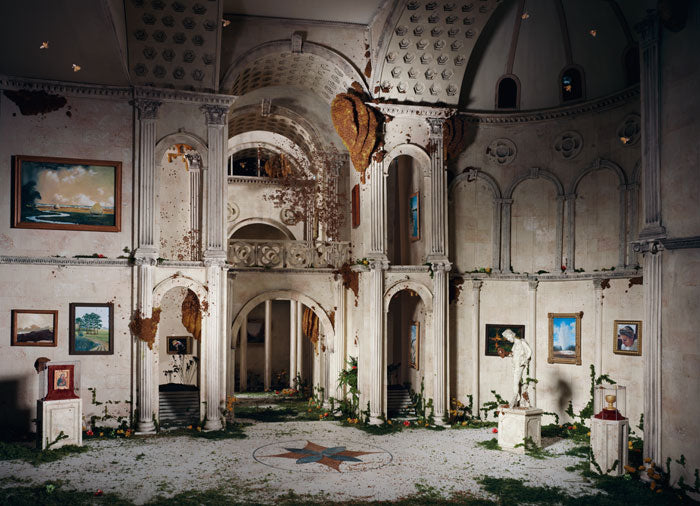
Strangely Haunting Photos of a Once-Royal Pastime

Elliott Wilcox, Rackets 03, Chromogenic Print Mounted to Archival Substrate


Here we take a look back at Leah Sandals' Q&A with Bau-Xi artist Elliott Wilcox, which sheds light on the inspiration behind Wilcox's award winning series Courts.


Leah Sandals, National Post

Friday, Jan. 28, 2011

If art was a sport, Elliott Wilcox might be seen as a future Grand Slam contender. In the past two years, the young U.K. photographer has won multiple international prizes for his strangely haunting series of work on racquet-sports courts. Now, with his first Canadian solo exhibition on in Toronto, Wilcox rallies with Leah Sandals about squash, space and Saatchi's art-reality TV show.

Q. I grew up in a squash-playing family, so these photos have nostalgic value for me. What drew you to this topic?

A. When I first started, I wanted to look into something that hasn't been looked into in photography so much--the idea of leisure. A lot of photography in England has looked at work. But I was interested in what people wanted to do in their own time, at their most
comfortable. So I started looking at spaces of leisure, from football grounds to cinemas. Through that I got into squash courts and real tennis courts.

Q. The marks left on the walls of these courts are fascinating, almost like drawings, aren't they?

A. They look amazing. I love the fact that it's history on the wall itself--the history of the game and of the people who have played. There's a great sense of time on the walls. One of the real tennis courts I photographed in the south of England was made in the 1700s with a special pigment. It creates a really painterly effect. What I'm fascinated by even more is the large space of these courts. It can be very overwhelming, especially when there's nothing else going on. When there's people there playing, it's about the sport. But when you're a spectator only of the space it becomes something completely different. A lot of these clubs are also prestigious. Queen's Club in Notting Hill is where lots of people play before Wimbledon. When I photographed their rackets court they'd just had it painted, and the members were upset because they thought the paint would make it play differently. That fascinated me, because you wouldn't think paint would make a difference. But if you've been there so long, maybe it does.

Q. Most North Americans aren't familiar with real tennis or rackets. What are these games?

A. Real tennis is the original version of tennis. Originally, it was played in a courtyard--a court --with sloped walls. The crowns on the walls relate to scoring. And there's other royal connections, too--many of these courts go back to the 1400s and are in palaces. Henry
VIII was a famous real tennis player. I went to photograph his court at Hampton Palace and actually had to pay to book a 6 a.m. Monday morning slot, because it's so busy. Rackets is the predecessor of squash, and squash was I believe invented for the poorer
man who couldn't get a rackets court. Picture a squash court and times that by four. They're often painted black, which is nice; it makes your eyes want to look around. It's a really fast and strong game, like firing a snooker ball around the room. I've heard it's
really dangerous as well.

Q. Do you find it difficult to play now that you're so focused on photographing courts?

A. I still play squash once a month. It hasn't stopped me. But it has made me think more. When I first started the project, I'd go to play and say, "I wish I'd brought my camera."

Q. In terms of treating art as a sport--you were a contestant on the BBC reality show School of Saatchi. What are the pros and cons of doing art that way?

A. I'm not that big a fan of reality TV. But the benefit was having the opportunity to work with big names like Tracey Emin and get some good feedback. I also met a lot of friends through that show. It's good in one thing and bad in another, but overall it was a good
experience.

Q. Does art perhaps contain a mix of discipline and pleasure that's similar to sport?

A. I believe that. This project is not quite an addiction for me, but I'm fascinated by these courts. It's been a whole process of meeting people, of research, of getting access to photograph. I also have a new series on another kind of constructed space --indoor climbing walls. I'm intrigued by what we bring indoors--we bring cinema indoors with home entertainment, say...when maybe it'd be better to get out and experience things.

Click here to view the collection

Read more

Michael Wolf in the Permanent Collection of The Rijksmuseum

Michael Wolf, Architecture Of Density 119, Bau-Xi GalleryMichael Wolf, Architecture of Density 119, Chromogenic Print Mounted to Archival Substrate


Michael Wolf, Industrial 01, Bau-Xi Gallery
Michael Wolf, Industrial 01Chromogenic Print Mounted to Archival Substrate

The Rijksmusuem in Amsterdam recently acquired two pieces for their permanent collection by internationally renowned photographer, Michael Wolf. Images and artwork details shown above.These images are from two of Wolf's iconic series', Architecture of Density and Industrial, which highlight the density of the urban landscape in Hong Kong.

Michael Wolf's work is held in many permanent collections around the world, including the Metropolitan Museum of Art, New York; Brooklyn Museum, New York; San Jose Museum of Art, California; Museum of Contemporary Photography, Chicago; Museum Folkwang, Essen; German Museum for Architecture, Frankfurt.

His work has been exhibited internationally in locations such as the Venice Biennale for Architecture; Aperture Gallery, New York; Museum Centre Vapriikki, Tampere, Finland; Museum for Work in Hamburg, Germany; Hong Kong Shenzhen Biennial; and the Museum of Contemporary Photography, Chicago.

Click here to read more about the artist and view available works

Read more

Jeffrey Milstein interview featured on BBC News

Jeffrey Milstein, NYC 55 Times Square, Bau-Xi Gallery Jeffrey Milstein, NYC 55 Times Square, Archival Inkjet Print Mounted on Archival Substrate


BBC News recently featured an interview with US photographer Jeffrey Milstein, where he discusses images from his highly anticipated new book, LANY: Aerial Photographs of Los Angeles and New York (Thames & Hudson).  Click here to hear more about how Milstein's lifelong passions for flight, photography and architecture come together in this incredible series. 

"[Los Angeles and New York] are the two cities that I know and love." - Milstein


Jeffrey Milstein interview featured on BBC News

Milstein's LANY series will be on display at Bau-Xi Photo until December 16. Visit us at 350 Dundas Street West to see these spectacular photographs in person. 


Read more about the exhibition here. 

VIEW THE COLLECTION


Read more

ARTIST Q & A: Darlene Cole on her latest exhibition KISSING TREES


Artwork details: "Kissing trees (stepped on a feather bed)," Oil on Canvas, 50 x 40 inches.


In advance of the artist's upcoming exhibition Kissing Trees, Bau-Xi Gallery sits down with Darlene Cole to learn more about her process. To offer a deeper perspective on Cole's conceptual touchstones, we asked her to comment specifically on one painting from the exhibition which captures the essence of this latest series.

Q: Your recent series “Kissing Trees” is, in your words, an exploration of the “wildly private”—the feeling that nature is a “room” or interior with its own sense of comfort and intimacy, but also an element of play, or danger. The figure in this painting—“Kissing Trees (stepped on a feather bed)”—appears to be inside a semi-abstract world of nature. Where is she? What is she thinking?


Darlene Cole: There are particular trees that I visit often in the historic parts of neighbouring towns. Every Saturday I walk by a pair of magnolias…which I believe may be evergreen magnolias (they had some blooms in September and still have their leaves in November). In full bloom, these trees are all-encompassing; I wanted this painting to have the feeling of a union between the figure and the canopy of the magnolia. There is very much an abstract quality to the blooms, and when I stand back there is such a haunting beauty to them as they converse with one another. I wanted to come closer to the Magnolia as I was painting, as if to preserve and protect it. At the same time, the figure could be viewed as the protector of the tree—a reciprocal relationship that works when both sides are listening. 


Q: Do you have ‘characters’ in the exhibition—I am thinking particularly of the woman in “Kissing Trees (unravel)” who wears a period hat in a three-quarter pose. I know each painting is a ‘relative’ of another, so wonder if this work has any companions.

Darlene Cole: The figures in “Kissing Trees” are wrapped up in textures/fabrics. The hat in “(unravel)” echoes the unraveling of silk or velvet ribbons and flowers. Rather than looking into the past, I wanted to contemplate the future with the simplicity of the blush background. I hope that all of the paintings in my show could be companions with one another in conversation. As I work in the studio, it is part of my comic relief to pair paintings side-by-side — often introducing two very different paintings—only to find to my surprise a great quirky conversation.


"Kissing Trees (wild roses)" in the artist's studio


Q:  Your painting technique is truly your own: your works are vibrant and textured, but somehow your brushstrokes also seem to fade away before our eyes, giving each scene a sense of weightlessness that unique to your practice. How does a painting begin for you? In the case of “(stepped on a feather bed)”, do you begin with your figure, or “character,” and build up the composition from there? Does the order of your painting correspond to how you conceive of each composition?

Darlene Cole: I work very intuitively—sometimes I start with the figure, sometimes the background. It really depends on where the figure is in the picture plane. It is actually more of a subconscious act for me—I feel my way through the work and the layering. I don’t plan out too much for a painting…if I do, I find then I have “done that” and I need to keep the excitement of something continuously unfolding. Working things out directly on the canvas for me is feeling the butterflies of the “first time.”

Cole's first concept sketch for "Kissing Trees"


Q: What is your relationship to palettes? In this piece, light, airy rose is anchored by deeper, mossy tones. The balance of values seems to say something about the narratives which inform your work. Can you speak to this marriage of form and story a little bit?

Darlene Cole: I think that there is a conscious tension—a mystery that I am layering in each painting.

Q: Can you tell me about the title: both “kissing trees”—which is your series title—and “(stepped on a feather bed)”?

Darlene Cole: We were driving on some back roads in a rainstorm. The rain was creating streams of water in the mud and the wind was bending the trees as they canopied over the road. In the fury of the storm I couldn’t help but think that the trees were comforting each other as they “kissed” over the road. There was something cinematic about it all, like an orchestra building to a climax. “(stepped on a feather bed)” is like hitting that moment of calm when you are caught in a moment. The feathers allow you to pause and sink in. I’ve always been intrigued with the interior existing in the landscape. The feather bed is a reference to that.

At a nearby estate, I experienced a smoke tree in full bloom. I went back a couple of days later with my paint smock and walked around the bowing branches in my bare feet. The sensation of the moss under my feet and the “smoke” around my head transported me. It is this union of nature and humanity—landscape and figure—that transcends me and makes me aware of the fragility of nature and how important it is for our bodies to listen and to feel nature. “Kissing trees”—they are whispering to listen, to feel, to protect.

The artist, Darlene Cole, visiting her inspiration


Q: The magnolia motif has appeared before in your paintings; what is your relationship to this imagery?

Darlene Cole: The magnolia fascinates me—hauntingly beautiful, the duality that it represents: fragility and strength. The blooms of the magnolia were pollinated by beetles because the trees appeared before bees did.

Q: Each of your paintings incorporates a marker of innocence—a child, a rabbit—some signal to memory. What is your marker in this latest series?

Darlene Cole: Kissing Trees incorporates a few markers: the rabbit, a clock, palm trees, and a crazy quilt— one that was left unfinished that I purchased from an antique dealer while working on this body of work. I see the quilt as a reference to Canada’s recently celebrated history, and particularly to women’s labour. I can feel the quilt in present tense more so because of its raw state and I see beauty in that. Many of the quilt’s colours are echoed in this show, the velvets particularly.

Darlene Cole's vintage quilt

Read more

Hugh Mackenzie | Recipient of Distinguished Educator Award

Hugh Mackenzie Receives Distinguished Educator Award

This November, Bau-Xi artist Hugh Mackenzie will be honoured with OCAD University's prestigious Distinguished Educator Award. Read below for the OCAD Alumni Association's biography on the acclaimed Canadian painter.  

HUGH MACKENZIE (AOCA, DRAWING & PAINTING, 1950)

Hugh Mackenzie was born in Toronto in 1928. He attended the Ontario College of Art (as it was then known), from 1946 to 1950. His instructors at that time included Carl Schaefer, John Alfsen and Jock Macdonald. The latter, according to Mackenzie, “came into the College like a breath of fresh air.” He continued his studies in Fine Arts at Mount Alison University, studying under Lawren Harris and Alex Colville. It was also at “Mount A” that he met Dorothy Johnson, another Fine Arts student, who would become his wife and critic for more than 60 years.

Mackenzie’s early working years included a two-year stint as a technical illustrator for the Avro Aircraft Company, where he illustrated manuals for the Avro Arrow. Since 1967, he has exhibited new works regularly in solo shows as well as with colleagues. His early high realist egg tempera works found a ready audience and led to a number of portrait commissions, most notably the state portrait of the Right Honourable Lester B. Pearson. Taking up etching in the mid-1970s freed Mackenzie from the exacting demands of egg tempera, helping him grow from the young painter focussed on the product, to a mature artist who takes pleasure in the act of painting itself. Trading in a fine sable brush for a palette knife, allowed him to switch easily between the representational and pure abstraction.

Teaching has been the other focus of Mackenzie’s elliptical career. In 1969, Mackenzie landed his dream job as a part-time instructor at the Ontario College of Art. He also served as a visiting lecturer at the University of Waterloo, the University of Victoria and other institutions, but OCA remained his primary teaching venue. Although his job title was often “lecturer,” he found his greatest success and enjoyment when he moved away from the podium to engage more directly with his students as colleagues. Learning to listen to, and learn from, his students, was key to his success as an educator.

Mackenzie was honoured to receive the A.J. Casson Award from the Alumni Association in 1991. More importantly, Mackenzie sees his success in the relationships that he developed with his students, many of whom have become accomplished artists, respected colleagues and life-long friends.

Text and image courtesy of OCAD University 

VIEW WORK BY HUGH MACKENZIE

Read more

The Surprising Range of Sylvia Tait in GalleriesWest Digital


Sylvia Tait’s recent Vancouver exhibitions were written up in GalleriesWest Magazine’s ‘Five Things’.  Best known for her works on paper, the exhibition at Burnaby Art Gallery illustrates the artist’s journey along her expansive, multidisciplinary career. Read the full write-up in GW Digital’s November 21 issue here.

Sylvia Tait's exhibition at Bau-Xi Vancouver is now over, but you can view the collection of available work in her online gallery here

Sylvia Tait’s retrospective at the Burnaby Art Gallery is on view until January 7.

Read more

Joshua Jensen-Nagle | New work

Joshua Jensen-Nagle at Bau-Xi Gallery Joshua Jensen-Nagle, Carry Me Away, 2017, Archival Inkjet Print Face-Mounted to Plexiglass, Back Mounted to Aluminum Subframe. 

Bau-Xi Gallery is thrilled to present ISRAEL, the latest series by prominent Canadian photographer Joshua Jensen-Nagle. Photographed in Tel Aviv, Jerusalem and above the Dead Sea, these striking large-scale photographs were debuted at Art Toronto 2017, where they received an enthusiastic response from collectors. Bau-Xi Gallery will feature this series next at CONTEXT Art Miami in December 2017.  


Joshua Jensen-Nagle, presented by Bau-Xi Gallery at Art Toronto 2017
Joshua Jensen-Nagle, Carry Me Away, installed at 70 X 30 inches at Art Toronto 2017


Joshua Jensen-Nagle at Bau-Xi GalleryJoshua Jensen-Nagle, Dead Sea Salts III, 2017, Archival Inkjet Print Face-Mounted to Plexiglass, Back Mounted to Aluminum Subframe.


Joshua Jensen-Nagle at Bau-Xi Gallery Joshua Jensen-Nagle, Strength in Memories, 2017, Archival Inkjet Print Face-Mounted to Plexiglass, Back Mounted to Aluminum Subframe.

Joshua Jensen-Nagle, The Western Wall, presented by Bau-Xi Gallery
Joshua Jensen-Nagle, The Western Wall, 2017, Archival Inkjet Print Face-Mounted to Plexiglass, Back Mounted to Aluminum Subframe.


Joshua Jensen-Nagle at Bau-Xi Gallery Joshua Jensen-Nagle, Summers in Tel Aviv, 2017, Archival Inkjet Print Face-Mounted to Plexiglass, Back Mounted to Aluminum Subframe.


UPCOMING EXHIBITION:
April 14-28, 2018
350 Dundas Street West
Opening Reception: April 14 from 2:00-4:00pm


VIEW THE FULL COLLECTION

Read more

Sylvia Tait Burnaby Art Gallery Retrospective

Bau-Xi Gallery is proud to announce Sylvia Tait's latest retrospective opening Thursday, November 16 (7-9 PM) at The Burnaby Art Gallery.

This survey of works on paper by the acclaimed West Coast artist includes ink drawings, digital drawings, prints, acrylic paintings, collages, posters and ephemera. While Tait is largely recognized as an abstractionist and a colourist, the exhibition will also include a selection of figurative works, with a particular focus on friends, family and the cultural community. 

Accompanying the exhibition is a special catalogue with an introduction by curator Ellen van Eijnsbergen and essay by co-curator Robin Laurence.

Sylvia Tait : Journey runs from November 17-January 7, 2018 and full exhibition and event details can be found by clicking here.

VIEW NEW WORK BY SYLVIA TAIT


Read more

Jeffrey Milstein featured in Fortune

Jeffrey Milstein aerial photography, Bau-Xi Gallery Jeffrey Milstein, NYC 55 Times Square, Archival Inkjet Print Mounted on Archival Substrate

Acclaimed American photographer Jeffrey Milstein is featured in the November issue of Fortune magazine. In this article, Milstein discusses his exciting new book, LANY: Aerial Photographs of Los Angeles and New York (Thames & Hudson), as well as his passion for aviation, his appreciation for architecture and what it is like to photograph two of the most famous cities in America from above. 


Jeffrey Milstein featured on the cover of Fortune

Fortune 500 issue cover, June 2016.  Photograph by Jeffrey Milstein. 

Works from Jeffrey Milstein's LA NY series will be exhibited at Bau-Xi Photo (350 Dundas Street West) for the month of December. Join us Saturday November 2 from 2-4pm for the opening reception, and launch of the new book. 

Click here to read the full Fortune article

Click here to read further press about the series: Milstein featured in Architectural Digest

Click here to read a review of Milstein's new book in Musée Magazine

Click here to view available work by Jeffrey Milstein

Read more

David Burdeny | New works from the acclaimed SALT series

David Burdeny photography for sale at Bau-Xi Gallery David Burdeny, Spiral Jetty 2 Great Salt Lake, Utah, 2017, Archival Pigment Print Face-Mounted to Plexiglass, 59 X 59 in., $11,550


Bau-Xi Gallery is proud to present new work by acclaimed Canadian photographer David Burdeny. 

These photographs were released exclusively with Bau-Xi Gallery at Art Toronto 2017, and mark the second iteration of the artist's hugely successful SALT series (released exclusively with Bau-Xi Gallery at Art Toronto 2015). 

With this collection, Burdeny returns to Great Salt Lake in Utah, once again producing beautiful topographic shots of the vibrantly colored salt making ponds. 


David burdeny photography for sale at Bau-Xi GalleryDavid Burdeny, Photosynthetic 2, Great Salt Lake, Utah, 2017, Archival Pigment Print Face-Mounted to Plexiglass, 44 X 44 in., $6450


These new works are presented in a contemporary plexi face-mount style, with a slim 1 1/4 inch profile.  A hidden aluminum channel on the back offers easy installation and a beautiful, frameless presentation.


David Burdeny featured at Art Toronto 2017
Art Toronto 2017, David Burdeny's new work debuted exclusively with Bau-Xi Gallery 

Photosynthetic 1, Great Salt Lake, Utah, 2017; Tangents 2, Great Salt Lake, Utah, 2017; Spiral Jetty 1, Great Salt Lake, Utah, 2017


David Burdeny photography for sale at Bau-Xi Gallery

David Burdeny, Tangents 2, Great Salt Lake, Utah, 2017, Archival Pigment Print Face-Mounted to Plexiglass, 44 X 44 in., $6450


David Burdeny, Halogens 1,  Great Salt Lake, Utah, 2017, Archival Pigment Print Face-Mounted to Plexiglass, 44 X 55 in., $6850


David Burdeny photography for sale at Bau-Xi Gallery

David Burdeny, Tangents 2, Great Salt Lake, Utah, 2017, Archival Pigment Print Face-Mounted to Plexiglass, 44 X 44 in., $6450

Read more

David T. Alexander On View at Audain Art Museum


David T. Alexander will be part of Audain Art Museum’s new exhibition Stone and Sky: Canada’s Mountain Landscape. 

The special Canada 150 exhibition profiles representations of expansive mountain vistas by the likes of Group of Seven Painters Emily Carr, Lawren Harris plus Takao Tanabe, Ann Kipling and others. 

Alexander's ‘Contrasted Day Drawing’ (pictured) and ‘White heat, Keremeos’ will be on view from November 11 until February 26 at the Audain Art Museum in Whistler.

Image details: David T. Alexander, ‘Contrasted Day Drawing', 2008


Read more

Artist Q & A : Sylvia Tait


1) The Bau-Xi Gallery feels a great sense of pride and gratitude in having the privilege of representing your work for forty years. 
Are there any touchstones in your practice or philosophy that have remained a constant theme or preoccupation over this period of time ?

Because the camera can reproduce almost any subject, place or incident in exquisite detail, it leaves the painter free to invent and insinuate oneself into a world of one’s own. This is both an advantage and a problem. People still insist the artist should try to become the camera. The inventor-painter can open other aspects of reality. That is challenging and one has to newly invent the world each time when starting a new work.


2) Double Entendres is an intriguing and heavily weighted title for your solo exhibition. Please explain the genesis behind it. 

Double Entendres have different interpretations or meanings which allow for poetics and insights, plus in this particular situation, my two exhibitions ( at Bau-Xi Vancouver and my retrospective at the Burnaby Art Gallery ) are running simultaneously but with different approaches and media and time sequences.


3) One immediately equates the word COLOUR in bold letters to your work in general. What role does colour play in your work ? 


Colour: That is hard because colour use is such a personal expression, possibly even cultural with those choices of values that become recognizable in place and context.

Emotions and deep or fragile feelings can be remembered through colour as well as the other prime senses. A coloured stroke put beside another hue or tone evokes a dialogue of its own for me.

Colour is love. 


4) The sense of sound is often strongly evoked in many of your titles such as Arpeggios, Diminuendo, Mumbo Jumbo, Clashes and Bangs, Sun Song with either their musical references, use of sound poetry, or references to human speech or sounds from the natural world.
How does music or sound inform or inspire your work ? Do you have any favourite composers or musicians or genres of music or a radio program or station that you often listen to while you paint or do you paint in silence ?

Music and soundscape is vital to me. In a time of great grief and trauma, I feel it was music that saved me from total despair. The abstract language of music speaks to the visual artist in the same way. The approach to the form and vitality of expression and feeling is similar. There is enormous happiness, excitement and humility in recognizing that unique understanding that is humanity at its best. 

I am from another era in today’s mass media hype. Classical music in most of its forms as well as contemporary composers and performers keep my CDs flourishing as well as the CBC ( when it behaves itself.)

Today I prefer chamber music, more intimate noting, although opera excites and thrills me with the marvellous voices that flourish today all over the world. The combination of theatre, sound and drama can’t be beat !


5) Another consistent theme in your titles seem to be about the journey or the transcending of boundaries or the reference to this particular place or geography that you call home for example: Coming from Away, Out of Bounds, Crossing-Ways, Pathways and Partings , Vancouver Sound-scape , West Coast Suite . 

Titles are a way of adding poetry, linking the message/subject and giving some insight to the art, with the necessity for naming. Often it can be more difficult than painting . 

The “Journey“ is a metaphor for a traveler in time and idea space. Every experience brings new questions and revelations not always digested at the same time , so pathways just lead the way as boundaries eventually get fragmented and blown away.


6) Please explain the difference and/or similarity between painting on paper and painting on canvas in your works as you typically include both media in your solo exhibitions.

Painting on canvas or wood or paper is quite different. Each surface has different qualities and different pigments seem to require special techniques. I love the sensuality and depth of colour of painting with oils for the canvases, but the racy fast drying acrylics work best for me on paper.

7) Congratulations on your upcoming solo retrospective at the Burnaby Art Gallery opening Nov 16th, 2017. What can we look forward to there that would be different from this upcoming exhibition at Bau-Xi Vancouver ?

A few years ago art critic, writer, and art historian Robin Laurence suggested a “look back” for a possible retrospective of my work. So I revisited old drawings and paintings from the very beginning. Things stored away not seen for years brought back new feelings that I could enlarge upon and add new vigour to my palette and confidence. The retrospective that the Burnaby Art Gallery has most generously offered to mount will consist of multiple paperworks done almost from the beginning of my Art Journey up to the present day.  I understand there will be a published catalogue as well.  

The upcoming Vancouver Bau-Xi exhibition consists primarily of new works on canvas as well as some new large mixed media paperworks. I am grateful for the tenderness and generosity of both galleries and curators.


8) And do you have any advice for young artists just beginning their artistic journey ?

Words for young artists …. .. keep the passion alive and trust your instincts.


VIEW MORE WORK BY SYLVIA TAIT

Read more
480 results
Continue browsing
Your Order

You have no items in your selection.