
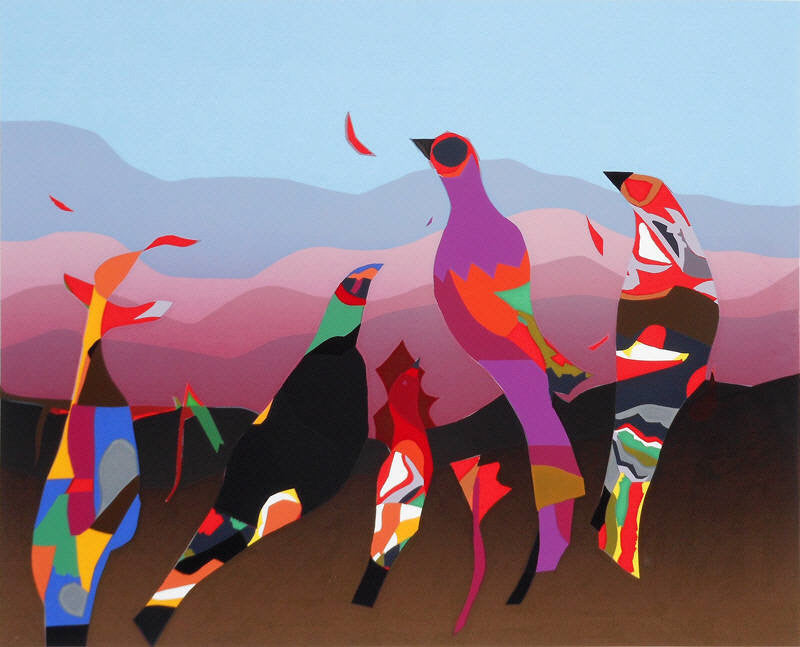
I Saw a Purple Bird … edition of 100
"I Saw A Purple Bird" is one of Shadbolt’s later works, produced in 1992, six years before he died. Birds are part of Shadbolt’s personal iconography - along with owls, butterflies, chalices and gardens - and he intended them as open possibilities of meaning rather than as symbols in the traditional sense.
Canadian artist Jack Shadbolt (1909–1998) was a Vancouver‑based painter and draughtsman celebrated for his influential role in 20th‑century Canadian art and modernist abstraction. Born in Shoeburyness, England, Shadbolt immigrated to Canada as a young child and went on to develop a prolific practice that encompassed painting, printmaking, public murals, and experimental print series.
Shadbolt’s artistic journey began with early studies at Victoria College and the Vancouver School of Decorative and Applied Arts, where he trained under Canadian modernist Frederick Varley. His education continued internationally with classes in London, Paris, and at the Art Students’ League in New York—an experience that broadened his visual vocabulary and introduced influences ranging from early Abstract Expressionism to Surrealism.
Over a career spanning more than six decades, Shadbolt’s work evolved from figurative and social realist roots into a bold, expressive idiom characterized by vibrant colour, dynamic form, and symbolic content. Many of his later works explore transformation, mythic imagery, and organic form, underscoring his lifelong interest in the interconnectedness of nature, identity, and culture.
Shadbolt also made significant contributions as a teacher and mentor. From 1938 to 1966 he taught painting and drawing at the Vancouver School of Art (now Emily Carr University of Art + Design), influencing generations of Canadian artists. With his wife, curator and writer Doris Shadbolt, he co‑founded the Vancouver Institute for Visual Arts in 1988 (now The Jack and Doris Shadbolt Foundation for the Visual Arts), providing awards and support to emerging artists in British Columbia.
Over his lifetime, Shadbolt received wide recognition, including a Guggenheim Award (1957), Molson Prize (1977), Gershon Iskowitz Award (1990), Officer of the Order of Canada (1972), and the Order of British Columbia (1990). His work has been exhibited internationally, including representing Canada in major exhibitions such as the Venice Biennale, and is represented in major public and private collections including the National Gallery of Canada.
Shadbolt’s long relationship with Bau‑Xi Gallery began in the 1970s, with the gallery presenting more than forty solo exhibitions across its Toronto and Vancouver spaces, a testament to his enduring influence and the continued relevance of his art.