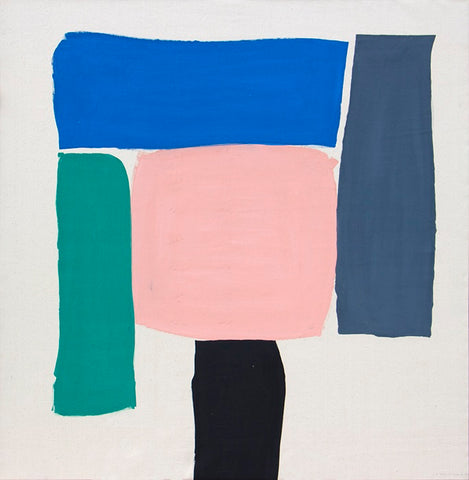
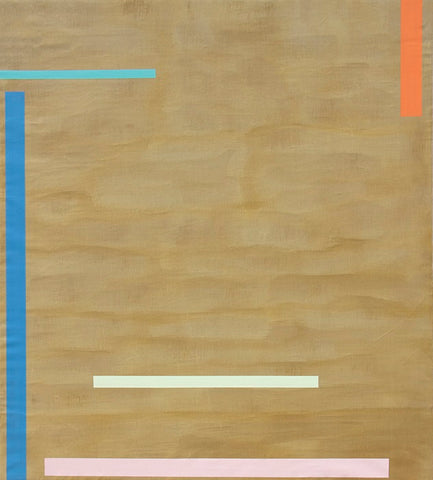
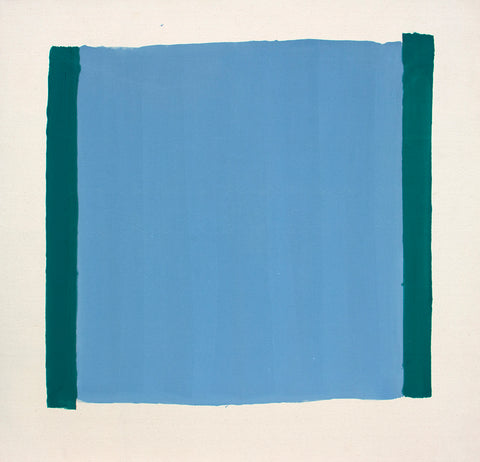
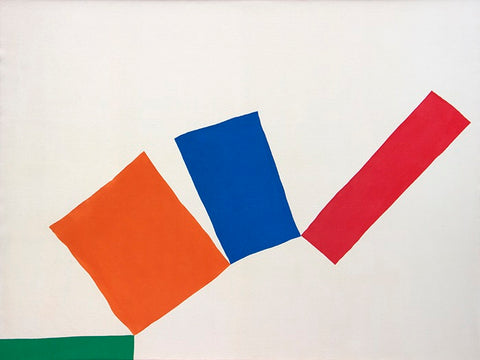
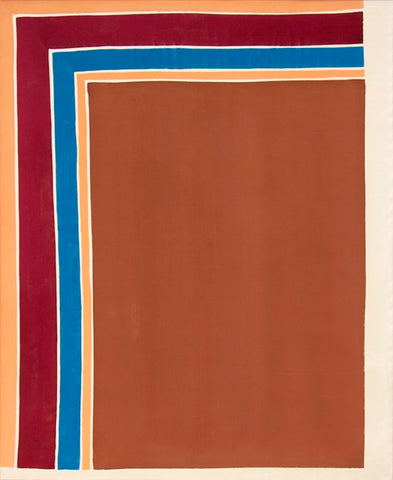
Orientlite, 1974
In 1970, following a year-long sabbatical, Kenneth Lochhead embarked on a significant new chapter in his painting practice. Replacing the brushes and rollers that had defined much of his earlier work with a spray gun, he developed a body of paintings that moved beyond the hard-edged geometry and carefully delineated colour fields of his previous years. These works marked a decisive shift toward atmosphere, gesture, and the expressive possibilities of colour.
Lochhead’s adoption of the spray gun was both a technical and conceptual departure. Working on unprimed canvas stapled directly to the floor of his studio, he moved around the surface, applying acrylic paint through a process that combined physical movement with precise control. The spray gun allowed him to work at different scales, from broad sweeps of colour to delicate, pencil-like lines. By adjusting the nozzle opening, the distance between the tool and the canvas, and the speed and angle of his movements, he could produce an extraordinary range of effects.
The resulting paintings possess a distinctive visual fluidity. Rather than relying on sharply defined shapes or rigid compositional structures, Lochhead allowed colour to become the principal subject of the work. Hues merge, overlap, and dissolve into one another, creating subtle shifts in intensity and depth.
The physical relationship between artist and instrument became central to the work. As Philip Fry observed in the 1972 Winnipeg Art Gallery exhibition catalogue, the paintings retain the evidence of Lochhead’s muscular activity while transforming it into a coherent visual language. The spray gun did not eliminate gesture; it offered a new means of articulating it. Each painting emerged through an accumulation of decisions involving movement, distance, colour, and timing.
_______
Kenneth Lochhead (1926–2006) was a pioneering figure in Canadian modernism and a central force in the development of postwar abstraction in Canada. As a founding member of the Regina Five, Lochhead helped shape a new visual language in Canadian art.
Lochhead studied art at Queen’s University, the Pennsylvania Academy of the Fine Arts, and the Barnes Foundation. In 1955, he initiated the Emma Lake Artists’ Workshop, where he worked alongside Abstract Expressionist painters and influential critic Clement Greenberg.
Lochhead’s paintings are celebrated for their bold chromatic relationships, refined geometry, and spatial clarity. Through carefully balanced compositions of saturated colour and linear form, his work achieves a sense of visual harmony and intellectual rigor. Each piece reflects a deep engagement with colour as both structure and subject, inviting contemplation through simplicity and precision.
His work has been collected by major institutions across Canada, including the National Gallery of Canada, Art Gallery of Ontario, Vancouver Art Gallery, and the Musee des Beaux-Arts de Montreal among others.